The Aesteria Codex //025: AI Content Writing Mistakes: What to Tell Your AI Not to Do
If you’re here to build something iconic, you’re in the right place. Subscribe by clicking here for weekly insights on brand building, psychology, and influence.
"Why does everything my AI writes sound so… AI?”
Well my dear, you’re in luck, because today I’m giving you the list your AI should have on what not to do, so that your content doesn’t come out sounding like generic fluff.
I’ve had dozens, if not hundreds, of entrepreneurs come to me asking me to create this resource, so that writing content (or scripting videos) using AI is as easy as possible. So here it is: my list of content Do Not Do’s that I feed my AI every time I write.
And if you’re using AI to help you create content, I’ve written a lot more to help you master it.
For the philosophy and bigger conversation around AI:
AI Slop Is Everywhere: what AI is doing to content right now, and where your brand draws its line.
Is It Ethical to Use AI for Your Content?: where using AI for your content stops being ethical.
For strategy and the practical how-to guides:
Where to Start With AI in Your Business: how to use AI without it changing how you sound.
How to Use Claude for Content Creation: what’s inside my Brand Codex, and what to train your AI on first.
How to Build Your Apex Personal Brand Step-by-Step (Using Claude): your brand kit, built before your AI writes for you.
Content Fluff: how to tell when a post uses a lot of words to say very little.
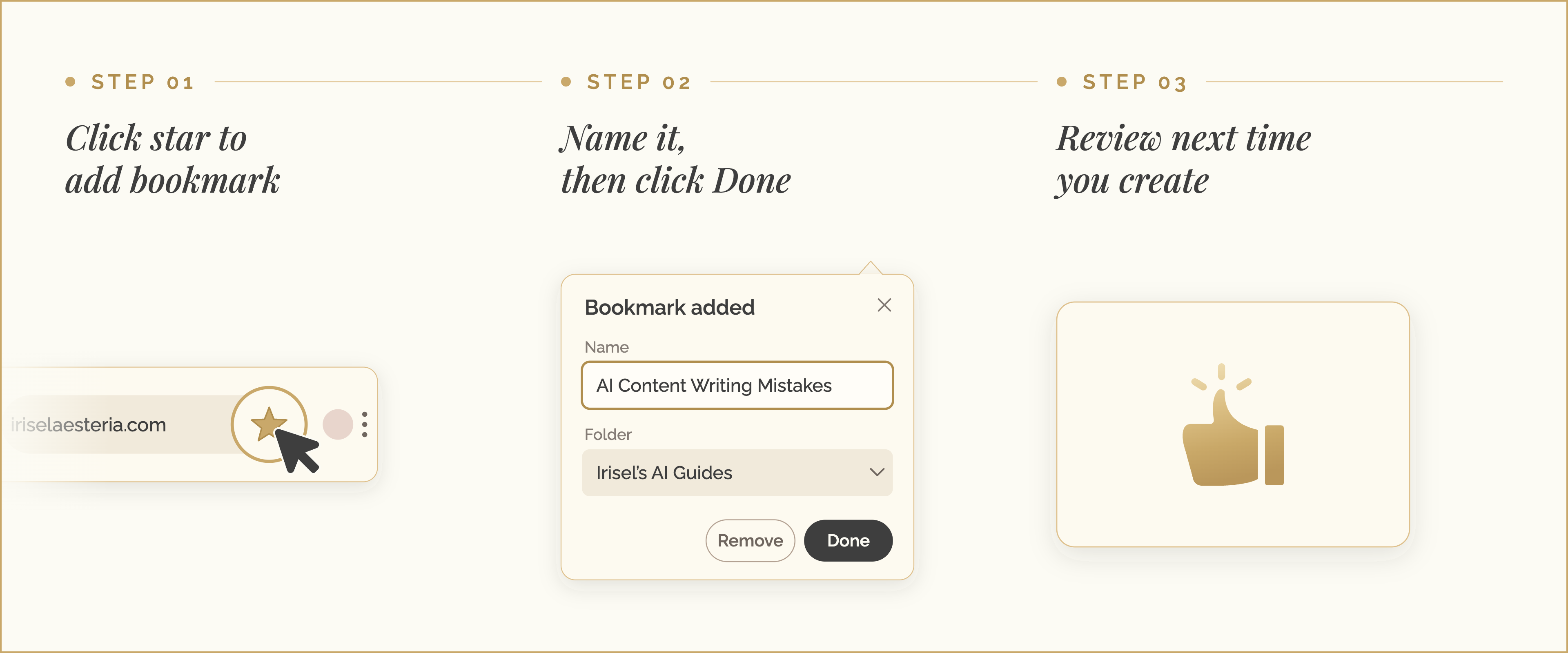
Before We Start, Save and Bookmark This Page
Before you scroll down, make sure to save and bookmark this page. Any time you’re creating content, whether it’s a carousel, a blog, a caption, an email, a Facebook post or a LinkedIn post, come back here and copy and paste the list directly into your AI.
My Content Do Not Do’s: What to Tell Your AI Not to Do
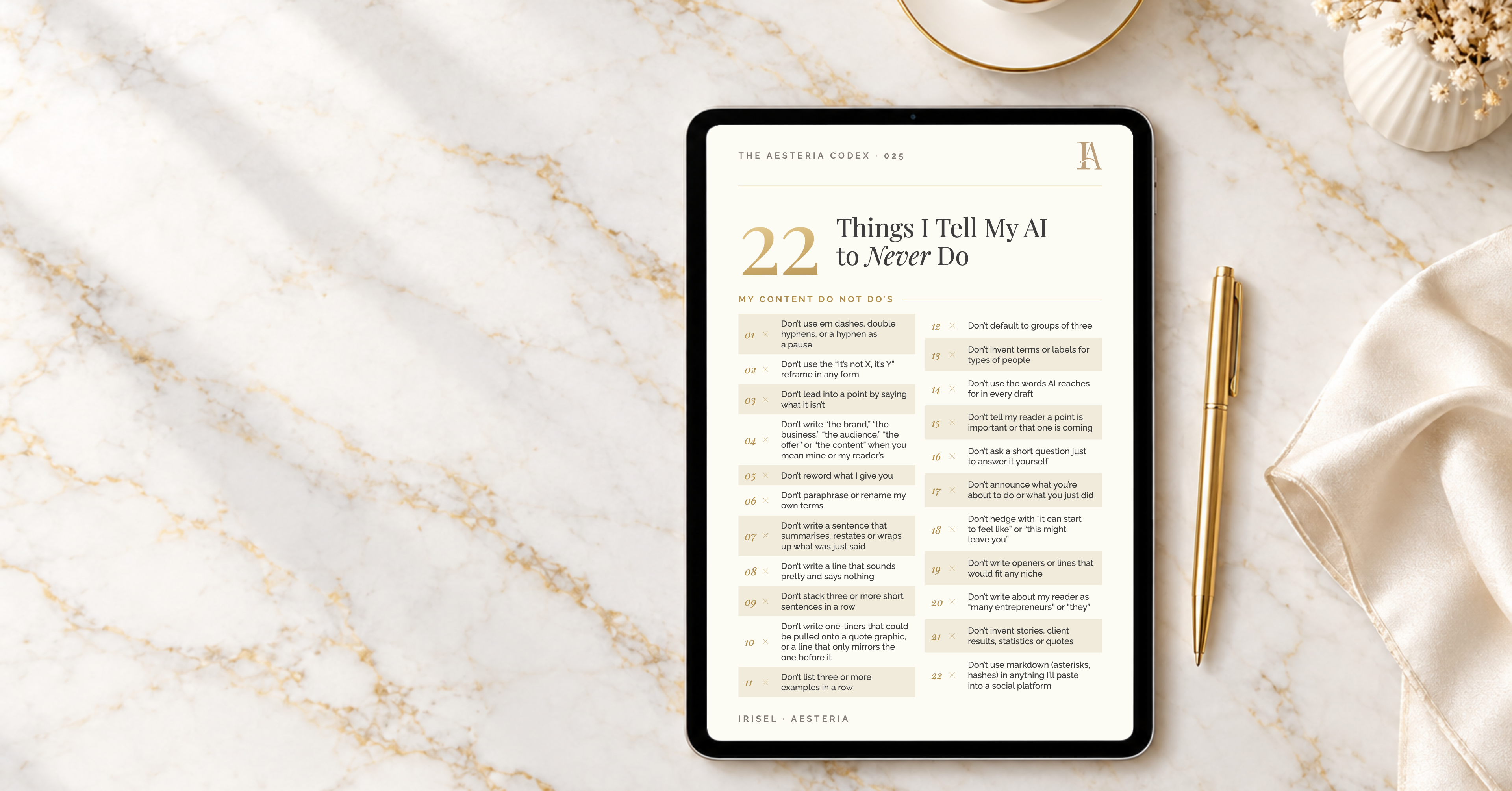
These are my for sure Do Not Do’s. They apply to everyone, no matter what industry you’re in, who your target demographic is, or what social media platform you’re creating content on. Copy the whole list and paste it straight into your AI.
Don’t use em dashes, double hyphens, or a hyphen as a pause: They leave a sentence unfinished, and they’re one of the fastest ways to spot AI writing. Write a new sentence, or use a comma, a colon or parentheses.
Don’t use the “It’s not X, it’s Y” reframe in any form: For example, “This isn’t a discipline issue. It’s a clarity issue.” It sounds decisive without saying anything. Say what is actually happening.
Don’t lead into a point by saying what it isn’t: For example, “Here’s what’s really going on, and it isn’t a discipline problem or a talent problem,” or “You’re not lazy. You’re not behind.” It invents an objection nobody had, just to knock it down. Go straight to what it is, and only say what something isn’t when my reader really believes it is.
Don’t write “the brand,” “the business,” “the audience,” “the offer” or “the content” when you mean mine or my reader’s: “The” makes it sound like it belongs to nobody. Write “my” or “your.”
Don’t reword what I give you: When I give you my wording, use it exactly, because my phrasing is what makes it sound like me. Only fix an actual grammar error.
Don’t paraphrase or rename my own terms: Use them exactly as I’ve defined them, with my capitalisation: [your list of terms].
Don’t write a sentence that summarises, restates or wraps up what was just said: For example, “Ultimately, this is what scaling actually looks like.” If my reader loses nothing when it’s removed, it doesn’t belong. Stop where the substance stops.
Don’t write a line that sounds pretty and says nothing: For example, “magnetic to the right person.” My reader only cares about their tangible problems and their tangible results. Anchor every claim in a symptom they have, a number, a named example or a specific scenario, and if you don’t have the detail, ask me for it.
Don’t stack three or more short sentences in a row: For example, “New offer. New message. New positioning.” When every sentence is short, none of them land. Write in flowing sentences, with one short line for emphasis at most.
Don’t write one-liners that could be pulled onto a quote graphic, or a line that only mirrors the one before it: For example, “Different on the surface. Identical underneath.” It reads like a slide deck. Write the way I talk through an idea.
Don’t list three or more examples in a row: For example, “The hit song. The tour. The cultural moment.” By the third one my reader is reading the pattern and has lost the point. One claim, one concrete example, then move on.
Don’t default to groups of three: For example, “clear, confident and magnetic.” AI reaches for three adjectives or three benefits every time, and the rhythm gives it away. Use the one word that’s true.
Don’t invent terms or labels for types of people: For example, “plateau brands,” “echo founders” or “signal architecture.” It sounds defined when it isn’t, and my reader has to decode it. Use plain words.
Don’t use the words AI reaches for in every draft: For example, “delve,” “unlock,” “elevate,” “navigate,” “landscape,” “game-changer,” or “in today’s fast-paced world.” My reader has seen them in every AI post this week. Use the plain word.
Don’t tell my reader a point is important or that one is coming: For example, “this changes everything,” “and that’s the whole point,” or “this has a name.” Make the point.
Don’t ask a short question just to answer it yourself: For example, “The result?” “The truth?” “The best part?” Say the result.
Don’t announce what you’re about to do or what you just did: For example, “Let’s dive in,” “In this post, we’ll explore,” or “In conclusion.” Start with the point and end on the point.
Don’t hedge with “it can start to feel like” or “this might leave you”: It hands my reader’s own experience back to them as a maybe. Write “it feels like” and “this leaves you.”
Don’t write openers or lines that would fit any niche: For example, “Are you tired of posting every day and seeing no results?” or “Step into the version of you that…” If anyone could have written it, it isn’t mine. Open with something only the reader I’ve described would recognise.
Don’t write about my reader as “many entrepreneurs” or “they”: It makes it sound like it’s happening to someone else. Write to “you,” and aim every symptom and every result directly at the person reading.
Don’t invent stories, client results, statistics or quotes: If you need a fact or an example you don’t have, ask me for it.
Don’t use markdown (asterisks, hashes) in anything I’ll paste into a social platform: It posts as literal symbols.
Additional Editing Recommendations: The Writing Rules That Depend on Your Own Brand Voice
These are the other rules inside my brand voice guidelines. Not everyone will apply all of them, but you’ll likely want most of them, so take the ones that fit your brand and add them to the bottom of your list.
The words and phrases you never say (especially if you notice your AI habitually uses them): For example, mine include “quietly” and “perform.” Tell your AI: Never use these words or phrases: [your list].
Your punctuation and formatting: I don’t use exclamation marks in my body copy, all caps for emphasis, or a run of emojis; yours might. Tell your AI: [your rule].
Phrases that were fresh once and are now everywhere: For example, “What most coaches won’t tell you…” Tell your AI: Don’t use [phrase]; say it plainly.
Questions that only exist to get comments: For example, “What do you think? Tell me below.” Some brands do okay with these; mine doesn’t use them. Tell your AI: Only ask a question the piece then answers.
Explaining what your reader already knows: It talks down to them. Tell your AI: Every section tells my reader something new.
Spiritual or abstract language with nothing inside it: For example, “You don’t need more purification, you need integration.” Tell your AI: If you use a spiritual or abstract concept, say what it means and what it looks like in practice.
Shaming your reader: For example, “If you’re still posting quotes and wondering why no one is buying…” Tell your AI: Point to the better way without making their current way a character flaw.
Trying to prove or convince: For example, “I know a lot of people say this, but I’ve actually tested this with over 30 clients…” Tell your AI: State the point and let the quality of the thinking carry it. Don’t argue with a reader who isn’t there.
Who your reader is: I never write “people.” Tell your AI: Name my reader by who they are: [entrepreneurs, creators, coaches, thought leaders, consultants].
Stories that stay about you: Tell your AI: Every personal story turns back to what my reader takes from it.
More than one idea in a post: Tell your AI: One post, one idea, one takeaway. If a second idea shows up, save it for another post.
How formal you sound: I write the way I talk. Tell your AI: Use contractions, and open every section by naming the thing in plain words.
What goes inside my full brand guidelines is a conversation I go deeper into in How to Use Claude for Content Creation.
More Practical AI Guides are coming, and next week’s is how to write a blog with AI. If you’re not on my list yet, subscribe here so it lands in your inbox.
To writing with AI that still sounds like you,
Irisel xx.

For founders ready to be seen at their full capacity. Subscribe to The Aesteria Codex by clicking here.